
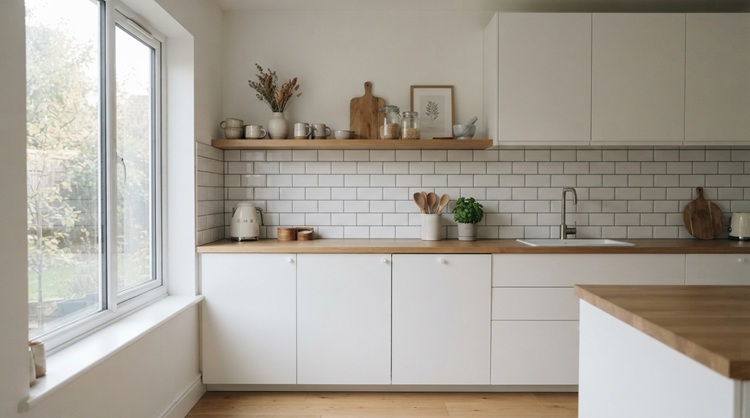
Some renovation decisions quietly alter the character of an entire room. This rarely requires knocking down walls or installing expensive fixtures. Often, the transformation lives in the material chosen for a single wall, and how confidently that material carries through the space. Natural stone achieves precisely that effect. Its distinct variation, depth, and unmistakable connection to the building itself transform a newly renovated interior from merely decorated into profoundly considered.
1. Extending the Design beyond a Single Room
One of the more interesting uses of natural stone subway formats is continuity. Instead of treating every zone of a property as an isolated design project, you can allow a material language to travel.
One of the more sophisticated ways to use natural stone is to let it travel. Perhaps the kitchen backsplash carries a related finish toward an outdoor entertaining area. Maybe the material around an interior cooking space visually relates to a covered patio bar. Larger formats like 6×12 or 12×24 establish that relationship without smothering every surface in identical patterns.
Note: Continuity differs fundamentally from uniformity.
An outdoor wall faces weather conditions entirely distinct from an interior backsplash, requiring Subway Backsplash Tile solutions suited to exact locations. Sometimes utilizing the exact same stone works best; occasionally, deploying a complementary finish creates the impression of continuity without forcing identical specifications everywhere.
Sometimes it is to use a complementary finish that gives the impression of continuity without forcing identical specifications everywhere. That requires someone to think about the property as a whole. For a homeowner investing seriously in a renovation, that kind of coordination can make separate rooms feel connected without turning the house into one enormous matching set.
2. Making Smaller Spaces Feel Less Restricted
Compact rooms often need more than good furniture placement. They need visual decisions that work with the dimensions rather than constantly reminding you of them. Proportions and directionality found in natural stone subway tiles handle this challenge remarkably well.
Horizontal natural stone subway tiles featuring elongated proportions create an optical illusion of width which can make a narrow space across a room feel more extended. In a powder room, galley kitchen or butler’s pantry, that seemingly small adjustment can make the space feel less boxed in.
The stone itself adds another layer. Carrara, for example, can introduce soft veining without visually overwhelming a confined area.
The important part is restraint. A specialist will consider:
- Wall length and ceiling height
- Grout color and joint scale
- Where the stone pattern begins and ends
- How lighting will reveal the natural variation.
The practicality of these subway tiles on enhancing space integrity doesn’t stop at transitions, it also prevents the room from feeling chopped up and smaller than its actual size.
3. Natural Marble in Wet Areas Requires More Than Good Taste
Natural stone and water can work very well together, but there is a dangerous habit in renovation conversations of treating marble as though it were completely impervious simply because it is expensive. Bathrooms and wet rooms demand a more serious conversation than simply asking whether marble “works” in a humid environment.
Natural stone can perform well in these settings when correctly selected, installed, sealed and maintained, but Natural stone is porous, and sealing doesn’t change that basic fact. A good sealer can improve resistance to staining and moisture, but it doesn’t turn marble into a waterproofing membrane. In a shower or steam room, the protection has to come from the complete installation system behind the tile.
That distinction matters. For a steam shower, bathroom surround or heavily used vanity wall, the installation needs to be designed as a complete moisture-management system. Waterproofing behind the tile, suitable setting materials, correct detailing and adequate ventilation all have roles to play.
The type of marble matters as well. This is where a specialist earns their place. They’re not simply choosing a stone that looks good in a showroom. They’re asking whether that particular stone and finish make sense for the conditions it will face every day.
4. Infusing Luxury without Turning the Room into a Showroom
Premium marble needs curation, not more of it. Calacatta Gold with its mirror finish and Calacatta Viola are good examples of why natural stone can completely change the feel of a space. Their veining can be dramatic, irregular and impossible to reproduce exactly. That is precisely what makes them interesting.
It also means you should be careful about simply buying the stone and leaving the rest to chance. A premium subway installation may work beautifully as:
- A restrained kitchen backsplash
- A fireplace feature
- A vanity wall
- A smaller statement area around an island or cooking zone.
The key is design curation. Natural stone is inherently variable, so experienced professionals pay attention to vein direction, color movement, batch consistency and how individual pieces sit beside one another. That level of attention is easy to underestimate. Two installations can use the same stone and produce completely different results.
For a homeowner or investor, this is why specialist workmanship should be viewed as part of the material investment. Premium stone deserves more than competent installation. It needs someone who understands where its natural character should be celebrated and where it should be allowed to settle quietly into the architecture.
Essentially, natural-stone subway tiling works best when it feels perfectly aligned to the property architecture and usage, rather than having been added to impress. The right stone, scale, layout and installation can give an ordinary surface real character. The skill lies in knowing how far to take it—and when the stone has already said enough.


